Text: Svitlana Prokopchuk
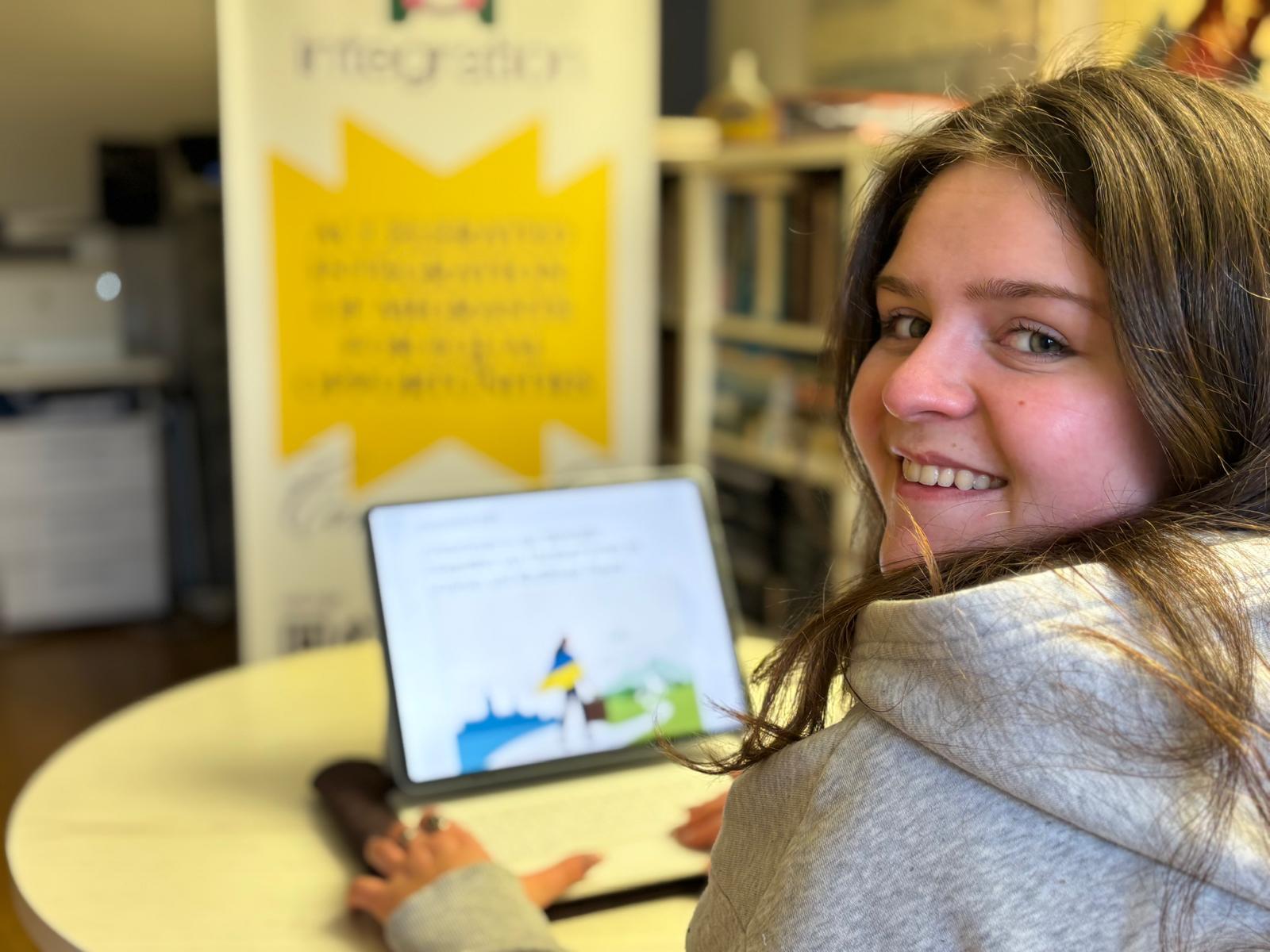
Vera Mezzera, 19, was born in Bern and has international exchange experience in Italy, where she lived for one year. She is currently in her final year at Kirchenfeld Gymnasium. As part of her Matura project, Vera engaged in research work for the first time and chose a topic that truly mattered to her: how Ukrainians integrate into Swiss society and why this experience differs so significantly depending on where they live.
The project is titled “Arriving in Switzerland: The Integration of Ukrainians in Urban and Rural Areas.” While working on it, Vera immersed herself deeply in real-life stories and, for the first time, realized how complex and multifaceted the process of integration can be. The search for participants was conducted in cooperation with the USB Association, which made it possible to collect diverse and meaningful data.
Within the project, Vera spoke with Ukrainians living both in cities and in rural communities across Switzerland. She combined questionnaires with personal conversations, allowing her not only to identify general trends but also to hear individual experiences and emotions.
One of the first insights was that people describe the reasons for difficult integration differently depending on their living context. “Ukrainians living in cities most often spoke about difficulties in finding work or having their diplomas recognized. Those living in rural areas, on the other hand, more frequently mentioned discrimination and a sense of social exclusion. This was unexpected and very important for me,” Vera explains.
Three Things Without Which Integration Does Not Work
As she continued her work, Vera gradually understood that integration cannot be reduced to a single factor. Three themes appeared repeatedly in conversations: language, social contacts, and employment.
Language proved to be important not only as grammatical knowledge, but above all as the ability to communicate with local residents, to hear the dialect, and not to be afraid to speak. Social contacts mean acquaintances, participation in community life, and the feeling of being seen and accepted. Employment, in turn, was often not only a source of income but also a way out of isolation, an opportunity to practice the language, and a means of building new connections. “For me, it was important to realize that these elements are closely interconnected. Without language it is difficult to find a job, without a job it is hard to build contacts, and without social contacts integration simply comes to a halt,” says Vera.
Why Social Integration Often Makes All the Difference
One of the strongest impressions of the project was the role of the social environment, especially in small communities. “In villages, communities are smaller, and therefore the need to be accepted and socially recognized is felt much more strongly,” Vera explains. This is clearly illustrated by the story of Vitalina (name changed), who arrived in the canton of Graubünden and initially lived in the small village of Schmitten. She quickly got to know local residents, took part in community events, and even organized cultural activities herself. Her children immediately attended regular school, quickly learned German and the local dialect, and her older daughter later secured an apprenticeship position. “Her story showed me that integration can be very successful if a person quickly finds contact with the community,” Vera concludes. This example helped her understand another important lesson: even the availability of language courses or employment does not guarantee integration if living social connections are missing.
Infrastructure Helps, but Does Not Solve Everything
A conversation with Eduard (name changed) drew Vera’s attention to another aspect—mobility and transportation. “In Kyiv, I spent an hour every day commuting to work. In Switzerland, in that amount of time, you can travel from Bern to Zurich or Basel,” he said. At the same time, Eduard pointed out that the daily cost of public transportation can be a serious challenge, especially for families with children or people with irregular working hours. This experience showed that good infrastructure creates opportunities but does not, by itself, ensure integration.
Spaces Where Connection Is Born
In many conversations, Vera noticed how important it is to have places where people can simply be together and do something collectively. “These can be clubs, centers, or any informal spaces. When people repair bicycles together or prepare food, connection arises naturally,” she says. This helped her realize that integration requires not only personal motivation but also conditions created by the community.
The Main Lesson: Integration Is a Shared Responsibility
The most important conclusion of Vera’s Matura project was understanding integration as a two-sided process. It happens not only through the efforts of newcomers, but also through the openness and support of the host society. Integration is not a single step and not a single program. It is daily interaction, a willingness to connect, and shared life within a communiti.