Text: Svitlana Prokopchuk
Humanity has been playing games throughout its history. But in the context of migration, play takes on a special meaning. It is no longer just entertainment — it becomes a way of gentle integration into a new environment. Games create a safe model of real-life situations: job interviews, house hunting, making acquaintances, public speaking, building partnerships. In this safe space, a person can experience challenging situations without fear of judgment, try different strategies of behavior, and learn to respond more calmly and confidently. Through repetition and group support, psychological stability is formed — the paralyzing fear of mistakes disappears, and an internal sense of security emerges. Just as an architect creates a model before construction, play helps “try on” a new reality before acting in it for real. And when a person allows themselves to make mistakes in a safe environment, they begin to adapt — not through stress, but through confidence.
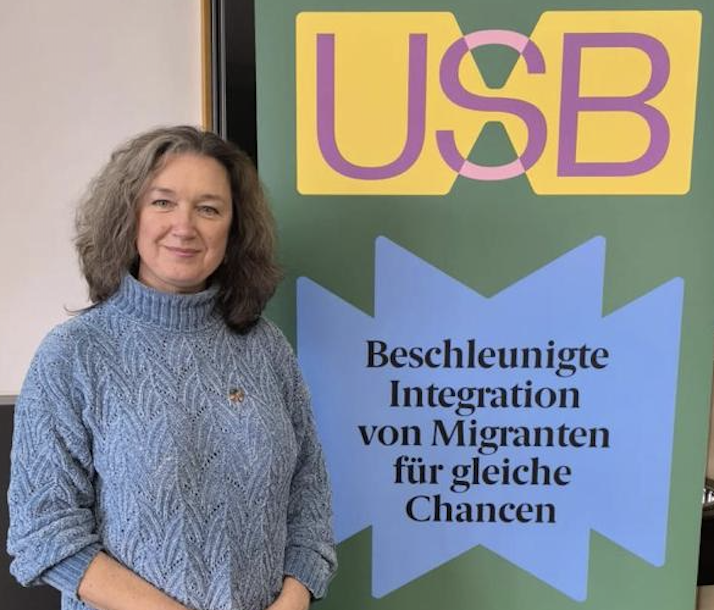
“Play is the creation of a model of life,” explains Svitlana Manzer, head of integration projects at the USB Association. “In a safe space, a person can experience a situation they would otherwise avoid in reality — and see themselves from the outside.” Svitlana has conducted hundreds of games, through which over a thousand people have found the key to success.
The Fear of Mistakes — Our Invisible Burden
Ukrainians arriving in Switzerland do not come only with suitcases. They bring with them their upbringing, experiences, and fears. “Our fear of mistakes is very deep,” says Svitlana Manzer. “We grew up in a system where mistakes were punished. In Swiss culture, however, mistakes are part of the process. But to allow yourself to make mistakes, you need to relax internally.” This often becomes an invisible barrier during job interviews, house hunting, or a first conversation in German. Anxiety shows as a lack of confidence or perceived incompetence.
A Small Life Cycle
Each game is a mini-model of life: start, rules, strategy, result. It includes room for risk, mistakes, and victories. “The most valuable thing is the feeling of success,” says Svitlana Manzer. “When a person finishes a game and thinks: ‘I did it.’ Even if it is a small step.”
In Swiss schools, children are constantly guided toward this feeling: you take action and see the result. Adult migrants often lack such experiences. They live in prolonged uncertainty without immediate positive feedback. Games restore this experience.
Integration Is More Than Just Language
Language is important, but integration is a deeper process. “It’s a way of thinking,” explains Svitlana Manzer. “In Switzerland, motivation matters. If an employer does not sense that you are genuinely interested in the job, your chances are slim. And this is read very subtly.” Through games, people learn to talk about themselves, maintain eye contact, pause appropriately, and present themselves calmly. “We even work on things like eye contact,” she smiles. “For many, this is harder than grammar.”
A Mirror in the Circle
Group play has another unique aspect — the mirroring effect. “Sometimes a woman sees another participant acting authoritatively and suddenly… recognizes herself. This is a very powerful moment,” shares Svitlana. “No lecture can create the same effect as live reflection.” Through play, a person begins to see their habits, automatic reactions, and stereotypes — the patterns that interfere with building new relationships in family, teams, and society.
More Than a Thousand Stories
Svitlana Manzer has been using game methodologies since the 1990s: first as a teacher, then as a school principal, and later as a facilitator of integration programs. “I have lost count,” she admits. “But it’s definitely over a thousand people. And every time, I see how the posture, gaze, or voice of the participants changes.”
In her work, Svitlana uses a wide range of games — from deep psychological to applied business and communication games. Among transformational ones, she mentions:
- Lila Chakra — a self-discovery game that symbolically reveals internal blocks and resources;
- My Space – My Resources — about restoring personal boundaries and energy sources;
- Genesis — understanding one’s life scenario and growth points;
- Crystal Balance (based on Positive Psychotherapy) — a tool for harmonizing life areas;
- World of Emotions — a game expanding emotional competence and teaching eco-friendly emotional expression; and the deep therapeutic game Satori, aimed at inner forgiveness and release from past burdens.
In the business field, she works with My Project — a game that helps structure ideas, from entrepreneurship to career or even motherhood strategic planning; and Funds Hunter — a game about grant thinking, planning, partnerships, and breaking stereotypes about funding.
A separate block consists of communication development games:
- Compliments — to overcome fear of mistakes and open communication;
- Networker — for networking skills;
- Media Start — for confident self-presentation and working with publicity;
- Time for Myself — for awareness of personal resources and balance.
Together, these tools create a system where play is not entertainment but a method for strategic thinking, self-reflection, and integration into a new environment.
When Play Becomes Strategy
For Ukrainians in Switzerland, play is not about fun; it is about choosing a strategy. Stay or return? Seek a new profession or develop the previous one? Create a personal project or integrate into the system?
“Play helps formulate what I really want,” concludes Svitlana Manzer. “Because when inner clarity appears, so does the most important thing — self-belief. Integration doesn’t start with documents. It begins with an internal permission: I can.”