Text: Olena Krylova
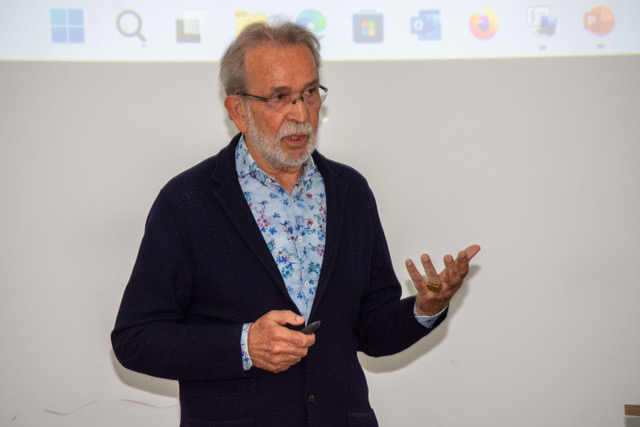
Based on a lecture by Prof. Theo Wehner, ETH/EGH, presented at the EntreCivil Symposium in Zurich on 24.04.2026
When we think of volunteering, we usually picture selfless people sacrificing their time for the well-being of others. A beautiful image — but, according to work and organisational psychologist Theo Wehner, also an incomplete one. After decades of research drawing on responses from over 15,000 volunteers across many European countries, Wehner argues that volunteering is far more than altruism: it is a psychosocial resource, an expression of personal values, a lived democratic practice, and a mirror of the working society in which it takes place.
If it were paid, I wouldn’t do it anymore
Wehner’s research journey at ETH began around the turn of the millennium with a single statement from an interview. When asked about her motivation, one interviewee cut the discussion short: “You know, if what I do here were paid, I wouldn’t do it anymore.” For a work psychologist trained in the tradition of income-securing labour psychology — and who had until then worked exclusively within that field — this was a challenge that had to be taken seriously. The prospect of payment radically calls into question the very motive of voluntary engagement.
Applications were submitted, projects launched, dissertations written — all examining what distinguishes volunteering from paid employment, and why classical work psychology had largely ignored it.
The first finding concerned definition. Volunteering, Wehner argues, requires a precise description: it is unpaid, organised, social work, performed personally and on a regular time commitment, which could in principle be carried out by a third party and potentially remunerated if a market for it existed. This clearly distinguishes volunteering from leisure, looking after grandchildren, or the “voluntary” attendance at an event. The definition matters because it ties volunteering to its social and democratic function — not merely to the investment of time and the goodwill of individuals.
Not personality, but values
One of the more surprising findings from the research is how little personality profiles explain who volunteers. What volunteers share is a pronounced orientation toward values. From the first philanthropic movements of the 19th century to today’s civil society organisations, voluntary engagement has always been driven by values — values perceived as endangered or urgently needed in a given social situation. People do not engage because of their character, but because of their convictions: *”What I do here says something important about who I am.”*
This has practical consequences. Volunteers are not simply “nice people” who want to be coordinated, thanked, and occasionally given a small token of appreciation. They are citizens acting out of conviction. They bring this seriousness to their work and draw personal meaning from it.
A European mosaic: Work culture shapes volunteer motivation
One of the most striking findings of the research group is its insistence that volunteering cannot be understood in isolation from the paid work culture in which it is embedded. Comparing motivations across several EU countries — France, Switzerland, Spain, Lithuania, Poland and others — revealed striking differences that only make sense within their respective social contexts.
In countries where collective experience in the workplace has significantly declined, the compensation motive is pronounced: people seek in volunteering what paid work cannot offer them — community, shared meaning, the sense of contributing to something larger than themselves. In countries where work already fulfils these needs to some degree, volunteering tends to be experienced as complementary to paid employment rather than compensatory.
For practice, this means that a schematic, one-size-fits-all approach to recruiting and supporting volunteers will easily miss what matters most. Anyone wanting to understand why people volunteer in a particular country must first understand what their working lives feel like.
The turning point at 34 hours
Drawing on extensive European data, Wehner presented a further finding on the relationship between paid working hours and life satisfaction. If life satisfaction is plotted on the vertical axis and weekly working hours on the horizontal axis, how does the curve look? The relationship takes the shape of an inverted “U”: low weekly working hours are associated with low life satisfaction, which rises as working time increases. However, between 25 and 34 hours per week, a turning point occurs: beyond this threshold, further increases in paid work lead to a decline in life satisfaction.
When researchers subsequently asked what people would do with their free time beyond this threshold, the answers were revealing. First came time for oneself. Second, time for family. Third: volunteering. Despite the growing individualisation of Western affluent societies, after the “I” comes the familial or relational “we” — and then, importantly, the “all of us.”
Meaning as a measurable resource
Central to Wehner’s approach is the concept of meaning. Drawing on the model of salutogenesis (“what keeps healthy people healthy?”), he argues that meaningful activities strengthen psychological well-being through three interconnected components: the ability to understand one’s own situation (*comprehensibility*), to manage its demands (*manageability*), and to experience it as significant — for oneself and for others (*meaningfulness*).
The data on meaning-fulfilment are compelling. In a representative study with samples from Switzerland, Austria and Germany, volunteers scored significantly higher on measures of meaning than the general population. Moreover, volunteer firefighters scored considerably higher on meaning satisfaction than professional firefighters.
The implications for the world of work are equally significant. The so-called *Fehlzeiten-Report 2018* (Absenteeism Report) compared employees with poor and good alignment between their work and their sense of meaning. Those with good alignment had just under 10 sick days per year, while those with poor alignment had 19.6. Meaning, it turns out, is no luxury. It is a resource for health and well-being — and it pays off for organisations too.
Protection from burnout in volunteering
Particularly striking in the lecture was the example of hospice work. Despite accompanying dying people — one of the most emotionally demanding contexts imaginable — professional palliative care workers frequently experience burnout, while hospice volunteers show significantly lower or no burnout levels.
The difference lies in the structure of the activity itself: volunteers retain autonomy over when and how they engage, receive meaningful collegial support, and are embedded in communities of shared purpose. After accompanying a patient until death, hospice volunteers take a break of several months before taking on a new case — a natural period of mourning and reorientation that is rarely, if ever, granted to paid staff.
This contrast points to something fundamental: well-designed volunteer organisations may be capable of protecting psychological well-being more effectively than many professional work structures — constrained as those structures are by profit-oriented imperatives.
Civil society under pressure
From the outset of his lecture, Wehner broadened the perspective to examine the current state of civil society. What was once regarded as an uncontested democratic good is now openly described — including in influential political publications — as ambivalent. Voluntary organisations are valued for their ability to fill gaps the state cannot reach, while at the same time being increasingly questioned: What are these organisations actually allowed to do? What should they leave alone? And are communities truly being served by organisations acting *on their behalf* — or rather by those working *alongside* them?
This tension is real and deserves to be named. For too long, Wehner argues, the voluntary sector has operated with a structural asymmetry: professionals and long-established residents design programmes *for* newcomers, migrants, or marginalised groups, instead of doing so *with* them. Overcoming this asymmetry is not merely good practice. It is a democratic imperative of our time.
A final word belongs to idleness
In a characteristically humanist conclusion, Wehner quoted the poet Gotthold Ephraim Lessing:
*”Let us be idle in all things / But not idle in love and wine / And not idle in idleness itself.”*
Lessing understood, Wehner observed, that even idleness is a form of activity — and that a truly humane society must make room for it too. After decades of researching what makes work meaningful, Wehner’s invitation is refreshingly simple: let us build societies in which people can engage fully in both work and leisure, and recover fully from both. As the evidence shows, both are necessary for a flourishing life.
This article is based on a plenary lecture at the EntreCivil Symposium on voluntary engagement and civil society. The EntreCivil project is funded under the EU’s Erasmus+ programme and, in Switzerland, by the Movetia Foundation. It supports the professionalisation of civic engagement among refugee women from Ukraine in Austria, Germany, Liechtenstein and Switzerland.
Photo Halyna Khramova