Text: Svitlana Prokopchuk
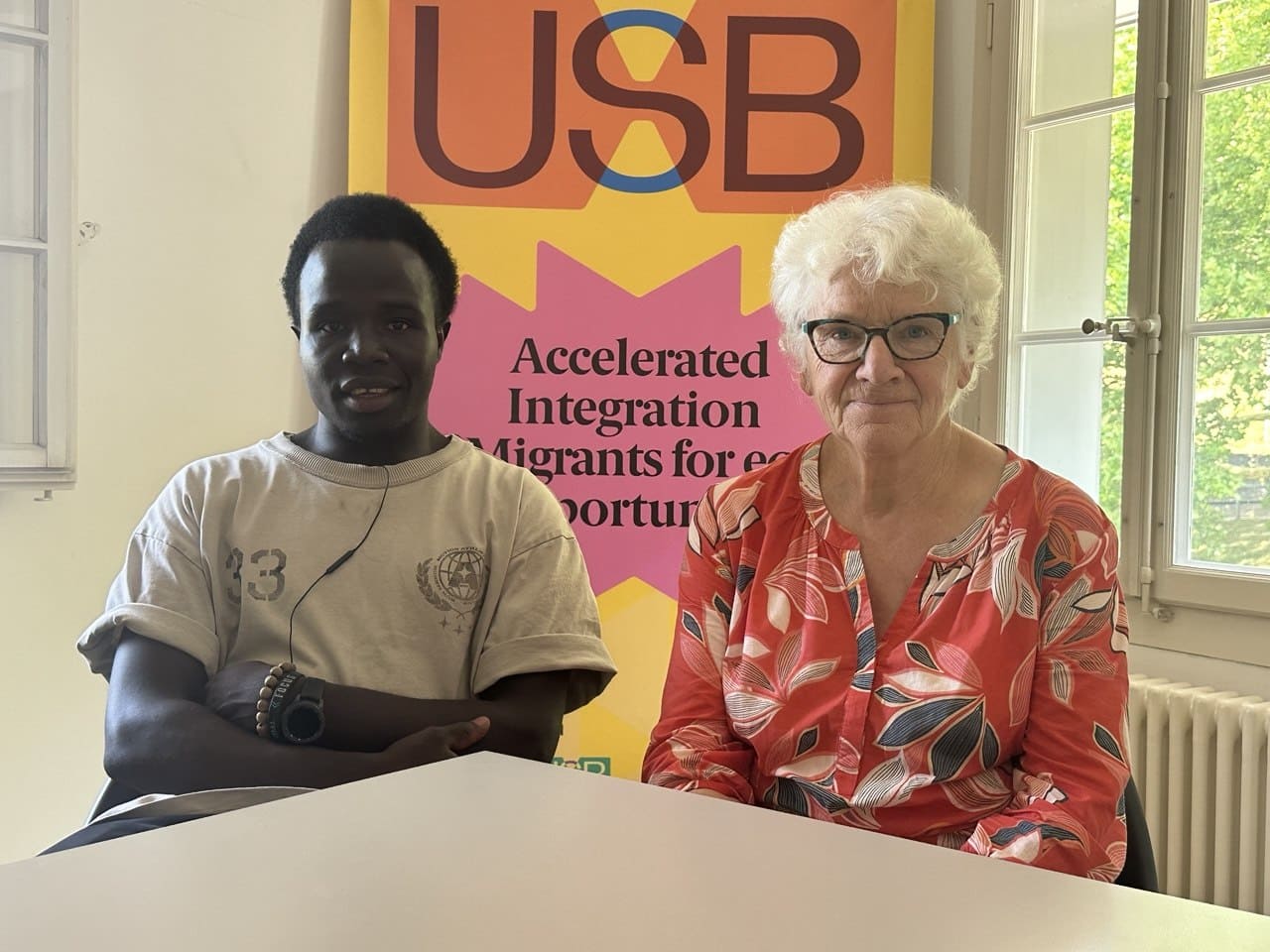
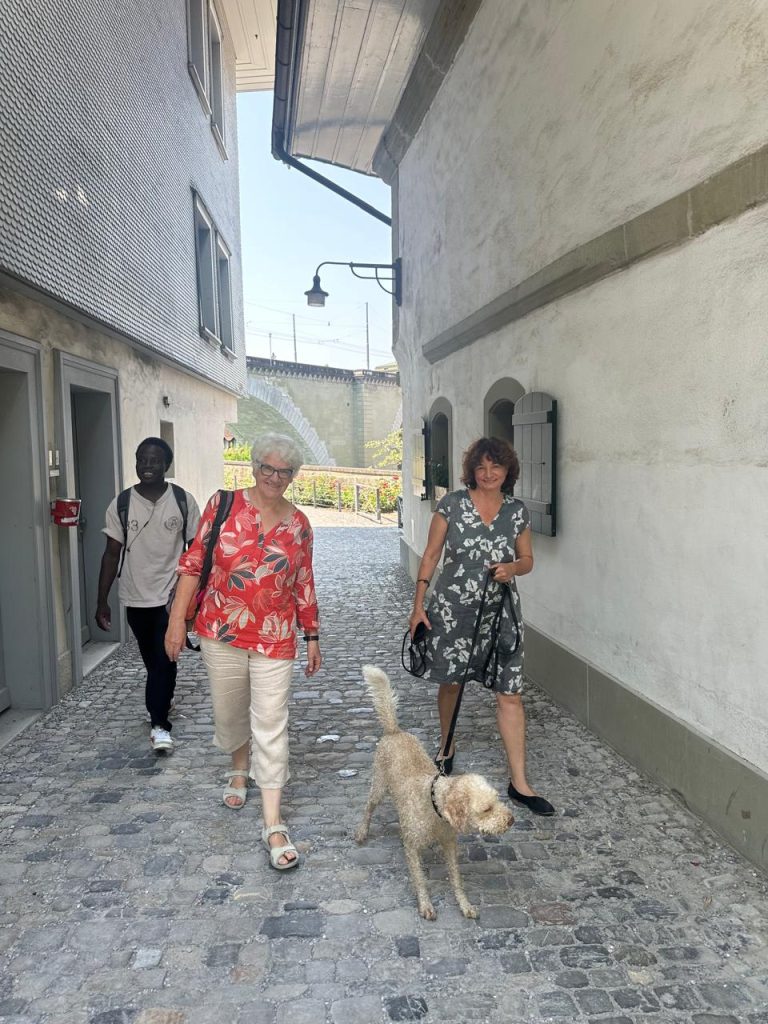
75-year-old Susanne Egloff has lived in Kriens near Lucerne for 24 years. However, she spent ten of those years abroad, working on various projects in countries of the post-Soviet space. Her work was always connected with people who depended on help and care at home. “This is a very pressing issue in all these countries because young people leave while the elderly remain behind and often have to cope on their own, living in loneliness and poverty,” says Susanne.
A “random” coincidence
After returning to Switzerland, Susanne came into contact with the issue of migration rather unexpectedly. The first such coincidence was a meeting with a young woman. “She held out her phone to me and asked: ‘Where can I buy this?’ On the screen, she showed me a packet of barley.” Susanne and the woman from Tibet searched together for a shop where the product was available at an affordable price. Afterwards, they exchanged phone numbers, and what began as a brief encounter developed into a longer relationship of giving and receiving.
“Once, N. had to go to the doctor, and I wanted to accompany her. However, the interpreter who had been contacted, a Tibetan woman without valid residence papers, arrived late and was fined 100 francs while rushing to catch the bus. Since someone had to pay the fine, this led to further contact with Tibetans and, with it, to a growing awareness of the need for support among refugees.” Later, following a chance encounter with an Afghan refugee woman, the issue of paying fines became urgent again. The woman had received a 100-franc fine. Because, as a refugee without valid papers, she also had no registered address, and because of her lack of language skills, the fine had increased to 1,000 francs. Susanne decided to help in this case as well because she found the situation unjust. She says: “I was ashamed of Swiss bureaucracy, which sometimes leaves no room for humane and dignified solutions.”
Susanne increasingly realised how many people who arrive in a new country are left to fend for themselves. This is particularly noticeable after a change in residence status. To be without papers and then suddenly receive a B permit feels like a small miracle. But it is also the beginning of great uncertainty. “Until then, you can practically do nothing, and afterwards you are suddenly expected to be able to do everything and, above all, not make a single mistake,” N. once told her. Susanne also began helping migrants based on her own previous experiences. She lived and worked in Belarus for four years and initially had only very limited knowledge of the local language.
“I experienced myself what it means not to know the language and not to be understood by others. That leaves a lasting mark on a person,” she adds. When Susanne realised how important language is for adapting to a new country, she completed training to teach German as a second language and run language courses. During the COVID pandemic, she was unable to conduct group courses. Instead, she taught individual lessons, and the language school referred people to her who needed additional support with their learning.
The greatest wish: to feel at home
For migrants and asylum seekers in Switzerland, waiting for a decision on their residence status is particularly difficult. It is an extremely stressful and frightening period that can sometimes last for years. When a person then receives a negative decision, meaning no asylum and therefore deportation, the situation becomes particularly difficult.
Susanne explains this using the example of the young M. from Guinea, who came to Switzerland two years ago. Since the young man has no documents, he cannot be deported from Switzerland. At present, he lives in a camp where he is only allowed to spend the night. Every morning at 9:30 a.m., he leaves the camp and looks for something to do until evening. “I go to the supermarket or to the library because I really enjoy reading. But it is particularly difficult in winter when it is cold. That is very hard for me,” he says.
His home country was once a French colony, so the young man speaks French. However, M.’s mother tongue is one of the country’s 24 national languages, and to this day he has not found anyone who speaks it and can help him with interpretation at the relevant authorities. To communicate better, he is learning German, the language of the canton where he lives. At the same time, he has hardly any contact with local people and therefore cannot use the language in everyday life, even though he studies it diligently. M. is not allowed to work. He volunteers and dreams of working in the social sector and caring for people. His greatest wish is to feel at home. He calls Susanne “Mama”, and their weekly meetings are an important fixed point in this life without prospects. If, after five years of residence, M. gets the opportunity to submit an application on the grounds of hardship and this leads to a residence permit, another challenging chapter begins. “Until then, you can practically do nothing, and afterwards you are suddenly expected to be able to do everything.” At that point, he is expected to already be integrated, speak the language, have a job and, as far as possible, not depend on the social welfare system, says Susanne.
Gifts of fate
Susanne’s experiences working with migrants have changed her. One particular opportunity came through a project that enabled people with surplus living space to enter into housing partnerships with refugees. Susanne decided to take in a refugee from Iran. “We went through the entire procedure, completed all the necessary checks and arranged a date for him to move into my apartment. One day before the move, the migration office told us: ‘No, this is not possible. He cannot simply change his living situation independently,’” Susanne recalls. It was only after two months of persistent discussions that it became possible. Since then, R. has been living with Susanne for more than two and a half years.
“For him, this was just one episode among many negative events. That constant feeling of being pushed back again and again. He had been on the road for years and experienced so much while fleeing his home country. And then he had to endure this as well,” she adds. Susanne describes every migrant she has helped as a gift. In the process, she has also found an answer to the question of what connects people with very different migration experiences. First, they are here now, and that alone connects them. Second, every person has specific reasons why they had to leave their home country, and no one has the right to judge them for it. The differences lie above all in the reasons for fleeing and in how people themselves explain them. For Tibetans, it may be karma: “It is simply my fate. Perhaps I did not live particularly well in a previous life. ”In Iran, it may be the political regime. And sometimes it is the last remaining hope: a climate that leaves people with no opportunities or prospects, for example because of drought or recurring floods.
What makes integration more difficult
For most newcomers, the main challenge is the language. Even the pronunciation in the everyday language we speak, with its different dialects, makes learning German quite difficult for them. The healthcare system is also complicated for newly arrived people. They have health insurance from the beginning, but they sometimes have to wait a very long time to receive the treatment they need. The situation in dental care is particularly difficult. Another challenge is a person’s personal background. Did the person even attend school? For people with education, experience and certain opportunities, integration is considerably easier.
People who have left a mark on her life
In her work with refugees, there are two people who have left particularly strong marks on Susanne’s life. One of them, R., founded a counselling centre for people without papers and has extensive experience working with different cultures. “Once, I complained to her,” Susanne recalls. “The Tibetans are really special. They never say thank you.” In fact, they are very grateful and considerate people, but they do not say “thank you”. R. replied that she herself had only come to understand this over time. “According to the Tibetan understanding, you improve your own karma by doing something good for someone else. That means I should actually thank them for giving me the opportunity to do something good.”
This changed Susanne’s view of the world quite profoundly. Living together with her Iranian housemate has also had an extraordinary influence on Susanne. She has even begun learning Farsi in order to understand his world better.
All names of refugees have been deliberately anonymised by the author.