Text: Svitlana Prokopchuk
The war has forced millions of Ukrainians to start their lives from scratch. At first glance, this process might seem easier in stable Switzerland. However, Maria Palamarchuk’s research suggests otherwise: even in a safe environment, people continue to live in a state of loss, uncertainty, and internal restructuring. Maria is from Kyiv, currently lives in Zurich, and studies at the Freies Gymnasium Zürich. Her research project, “Psychological Resilience Among Displaced Ukrainians in Switzerland,” has reached the final of the national competition Schweizer Jugend forscht.
Based on a survey of 183 Ukrainians, the researcher identified a paradox: despite a high level of traumatic experiences, the majority demonstrate moderate or even high psychological resilience. However, this resilience is not about returning to a “normal life” that no longer exists. Rather, it is about the ability to continue living in a new reality where the future is uncertain and the past cannot be restored.
The study also challenges the common assumption that “younger people are stronger”: age has little effect on the ability to adapt. Instead, other factors become decisive—mindset, access to support, and level of education. These determine whether a person can not only withstand a shock but also rebuild their life. At the same time, a central challenge remains: Ukrainians are learning to recover, but have not yet learned to fully move forward. Under conditions of war and temporary status, even stability does not provide a sense of grounding—it only offers a pause between the past and an unknown future.
— Maria, what was the starting point of your research?
My personal story. I went through the process of forced adaptation in Switzerland myself and wanted to understand how other Ukrainians cope with it—of different ages and with different experiences. For me, this research is not only about numbers, but about people within a large process of forced migration. Even in a stable country, this process turns out to be difficult: people still have to recover and find new points of support.
— You reinterpret the concept of resilience. What is the main idea?
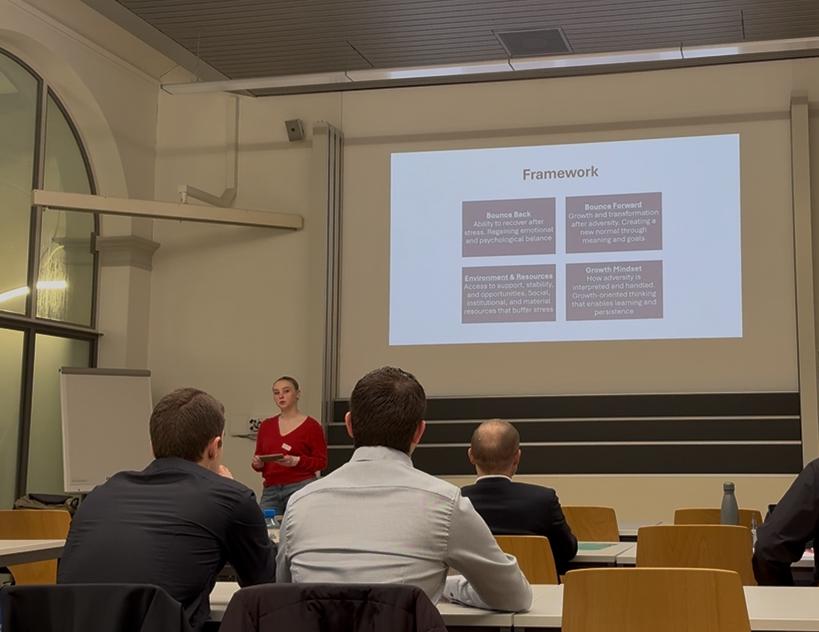
Traditionally, resilience is understood as the ability to “bounce back” after a crisis. But after war, this is impossible because the previous life no longer exists. That is why I use a different approach—”balance forward”: not restoring the past, but moving forward through change. It is not only about endurance, but about transformation. Several factors become important at once: lived experience, the ability for daily recovery, environment, and mindset. And the same level of resilience can mean different things depending on what a person has gone through.
— Does age influence the ability to adapt?
My hypothesis that younger people adapt more easily was not confirmed. Age hardly determines the level of resilience. However, it does influence the way people cope with difficulties. Younger individuals are usually more flexible and tend to believe more in their ability to shape the future. Older individuals rely more on their life experience and environment. This is also reflected in their plans: younger people more often see their future in the new country, while older people think about returning. But this is not about strength or weakness—it is simply about different life strategies.
— Which factors most influence the resilience of Ukrainians today?
First and foremost, the environment. The feeling of acceptance—or, on the contrary, discrimination—strongly affects psychological well-being. Education also plays an important role: I found a clear positive correlation between the level of education and resilience. At the same time, most people have experienced serious traumatic events: losses, a decline in quality of life, and a loss of dignity. The figures are difficult to call optimistic: about 80% have experienced traumatic events, 33% have lost loved ones, 41% have faced discrimination, 65% reported a loss of dignity, and nearly half noted a decline in quality of life. And this experience does not disappear—it can create a long-term sense of instability, as if life remains temporary.
Yet despite this, there is also a powerful resource in people’s responses—faith. Faith in the end of the war, in the possibility of returning, or in building a new life. And it is precisely this faith that often becomes what helps people move forward.