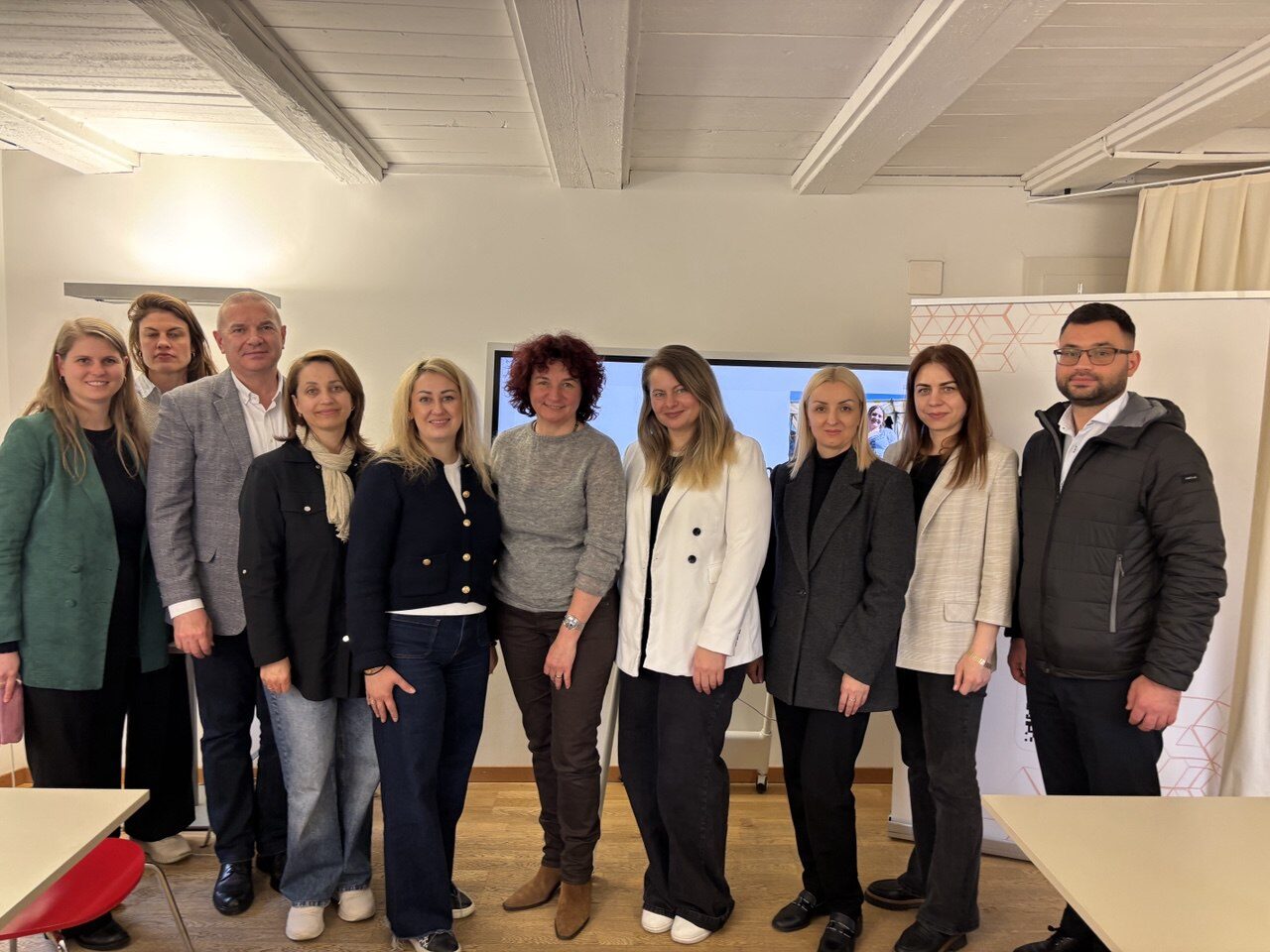
A Moldovan state delegation visited USB in Bern to compare notes on what actually enables displaced Ukrainians to rebuild — an exchange supported by UNHCR and SEM
Text: Olena Krylova
This week USB hosted a state delegation from Moldova for a working exchange on a question both countries answer daily, at very different scales and with very different resources: what conditions actually allow displaced Ukrainians to move from arrival to self-reliance? The visit was supported by UNHCR and the Swiss State Secretariat for Migration (SEM), which facilitated the exchange and networking.
Moldova hosts more refugees per capita than almost any country in Europe, with a fraction of Switzerland’s administrative and financial capacity. Precisely for that reason, the conversation focused not on budgets but on preconditions — the structural choices that determine whether protection turns into participation. From four years of Swiss practice, USB put five on the table.
Five preconditions
1. Legal certainty from day one. Switzerland’s Status S gave displaced people immediate residence and, critically, immediate access to the labour market. Where the legal status is clear early, people plan; where it is provisional and revisited, they wait. The single most cost-effective policy decision is clarity.
2. Work rights are not enough — recognition pathways are the bridge. A permit to work does not translate a Ukrainian diploma, a career or a portfolio. Structured routes for recognising qualifications and for realistic requalification decide whether an engineer works as an engineer or remains permanently below her competence — at a cost to both the person and the host economy.
3. Language tied to a professional goal. Language courses succeed when they are connected to a concrete next step — a profession, a certification, an apprenticeship — rather than taught as an end in themselves.
4. Communities as actors, not target groups. The most durable results USB has seen come from structures displaced people build and run themselves — media clubs, professional hubs, employment information channels. The state’s role is to open doors and fund reliably; people walk through them on their own.
5. Municipal ownership with clear responsibilities. Switzerland’s cantonal and communal system distributes both the task and the accountability. For Moldova — currently consolidating its own local-government landscape — the lesson is less the federal architecture than the principle: the level of government closest to daily life needs a defined mandate and the means to carry it.
Why this exchange matters now
Both countries are advocating for what the delegation and hosts alike called clever migration policy: policy built on evidence of what enables people, not on assumptions about what they lack. Exchanges like this one — practitioner to practitioner, state to civil society — are where that evidence changes hands.
“Moldova and Switzerland are answering the same question with very different means,” says one of the delegate members from Moldova. “But the preconditions are the same everywhere: clarity, recognition, language with a purpose, communities that act — and a municipality that knows it is responsible. Everything else is implementation.”