Text: Svitlana Prokopchuk
The rights of children with disabilities are formally well protected in modern European societies. International documents, particularly the UN Convention on the Rights of Persons with Disabilities, guarantee them equal access to education, leisure, healthcare, and participation in society. In practice, however, there often remains a significant gap between legally established equality and real life.
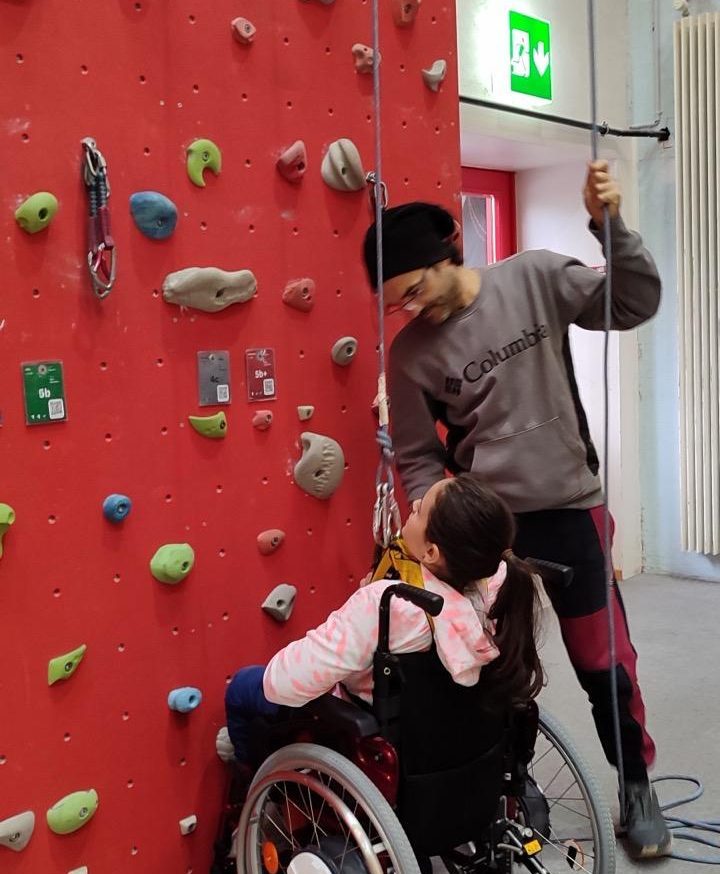
For children with disabilities, fundamental rights include not only access to school or medical care. They also involve the opportunity to be part of an ordinary childhood: to play with other children, to use public spaces, and to participate in sports and cultural activities. It is precisely these “everyday” things that are most often made inaccessible by barriers—both physical and social.
Barriers That Are Not Always Visible
The most obvious obstacles are architectural: the lack of ramps, elevators, adapted transportation, or accessible playgrounds. Equally important, however, are the so-called “invisible barriers. These relate to societal attitudes, stereotypes, and a lack of awareness. Disability is often perceived as an exception to “normal” life rather than as a part of it. This leads to the isolation of children, even when nothing is formally prohibited to them. Another systemic challenge is unequal access to inclusive education. In many cases, children with disabilities are either taught separately or receive support that strongly depends on their place of residence, the school they attend, or available resources. This creates a situation in which equal rights exist, but their implementation is unequal.
Why Empathy Matters
Empathy in the context of inclusion is not only an emotional category. It is a social instrument that enables society to perceive the experiences of others not as an abstraction, but as reality. Children with disabilities often face not only physical limitations, but also the fact that their lived reality remains “invisible” to the majority. Therefore, it is important not only to create infrastructure, but also to change societal perception—from compassion as a passive reaction to understanding as an active stance. In this context, empathy means the ability of society to recognize that childhood must be equally accessible to all—regardless of physical conditions.
A Symbolic Action as an Attempt to Make the Problem Visible
With precisely this goal, a public action is being prepared in Switzerland to draw attention to the rights of people with disabilities. One of the participants, the father of a child with a disability, Muzzafer Şana, will gather with like-minded people on May 2, 2026, at Helvetiaplatz in Zurich to emphasize the need for a more inclusive society. “We want to unite our voices. This concerns not only us, but society as a whole. We invite everyone to join us and support us,” says Muzzafer.
A special element of the action will be a symbolic visual gesture: during the march, he will carry a cardboard construction in the shape of a wheelchair on his back. This is intended to attract the attention of passersby and encourage reflection on the everyday lives of people with disabilities. The participants formulate their message simply, yet meaningfully: “Playing in the park is also a right for children with disabilities.” “Please have empathy—the things you see are what we live and feel,” adds Muzzafer Şana.
Inclusion Is More Than Infrastructure or Laws
Inclusion is not only about infrastructure or legal frameworks. It describes the ability of a society to see children with disabilities as equal participants in a shared social space. Where accessibility is lacking, empathy can arise. But empathy alone is not enough without structural change—just as laws cannot function without a shift in societal attitudes. An inclusive society begins with a simple recognition: the right to be a child is a right that must have no limitations.