Text: Maryna Bondarenko
There is a room in Bern where a woman from Brazil picks up a brush next to a woman from Turkey, and neither of them has painted anything in twenty years. By the end of the afternoon, both have a canvas. And often, one of them has been quietly crying — not from sadness, but from relief.
This is what happens, regularly and without fanfare, at the USB Art Studio. Around 150 people pass through it — from Ukraine, Brazil, the United States, Moldova, Turkey, and beyond — across locations in Bern and Burgdorf. They come with different backgrounds, different languages, and different reasons. What they find is the same: that making something with your hands, in a room where no one is judging you, does things that are difficult to explain and impossible to fake.
The therapeutic dimension was not designed in advance. It revealed itself. Women arrived without experience, or after decades-long breaks, stood in front of a blank canvas, and found that something shifted. “Because in safety and among the colours, what hurt came out.” Safety, colour, and the simple act of creation turned the studio into an unexpected container for grief, displacement, and the slow work of rebuilding a sense of self.
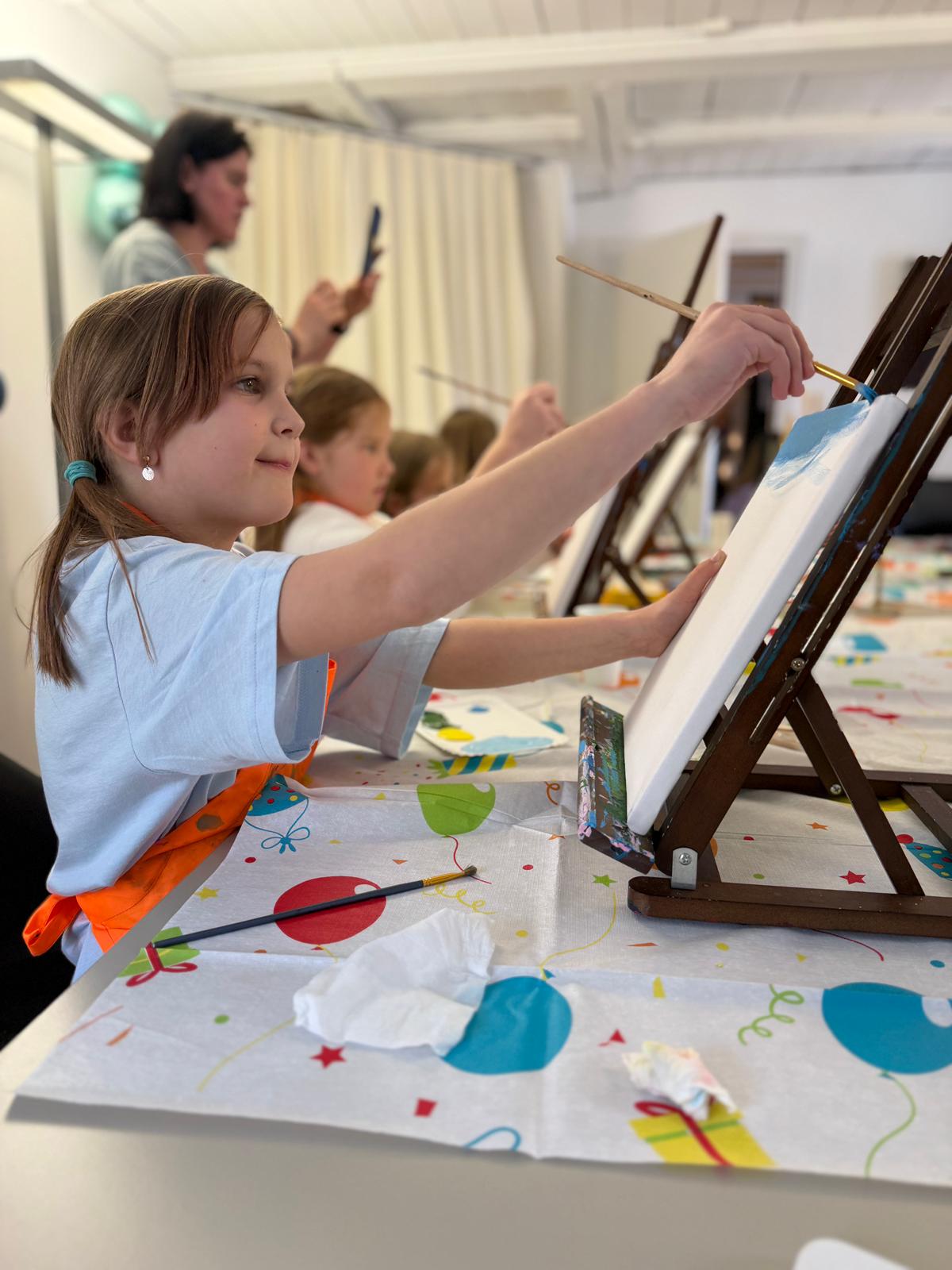
For children, the effect is different in form but not in essence. In the studio’s children’s classes, painting is not a lesson in technique — it is an invitation to exist freely. A child who is still finding their footing in a new country, a new school, a new language, discovers in art a way of being present that requires none of those things. The brush does not ask where you are from. The canvas does not care how well you speak German. What emerges is expression, and with it, something that looks very much like confidence.
The studio now runs across three directions: children’s art classes, alternative academism for adults, and art therapy proper. Each serves a different need, but all share the same underlying logic — that creative expression does what talking sometimes cannot.
The community that has formed around it has taken on a life of its own. Former participants have found collaborators, and rediscovered capacities they had set aside long before displacement entered the picture. The studio has become less a class and more a living network — one that grows because the people in it grow.
USB Art operates on the belief that art is not a luxury category in the integration process but a core one. For people navigating a new country, a new language, and a fractured sense of identity, a studio that asks nothing except that you show up and make something can be — quite literally — the ground under your feet.